
A man sits alone on a worn couch in his family's living room in the middle of the day, family photos on the shelves behind him, staring at the floor, hands clasped in his lap.

WHO WE WORK WITH

Successful on paper. Shutting down at home.

He provides. He shows up. On paper, his life works.

At home it's different. He's numb where he used to feel something, short with his kids, and miles away from his wife on the same couch. He can sit in the middle of his own living room, family photos on every shelf, life going on around him, and feel like he's watching it from the outside.

Behind many men's coaching businesses is someone who has dedicated their work to helping men like him find a way forward.

Those are the businesses Mercer Shift Media helps reach the men who need them.

The patterns we carry don't always begin where we notice them.

Sometimes the way we respond to a situation today has connections to experiences from years earlier.

The beliefs we developed, the ways we learned to protect ourselves, and how our nervous system responds to stress can all influence our relationships.

Here's one example of how those connections might unfold.

A young boy stands in a lived-in kitchen holding up a math test marked A+, his face falling, while his father sits at the table on a phone call, laptop open, one hand raised in a "one second" gesture, not looking at the paper.

01 · Childhood

The experience

A young boy comes home from school bursting. He got one of the highest marks in the class on his math test. He holds the paper up to his dad, waiting for the reaction. His dad is mid phone call, laptop open, work spread across the kitchen table. He glances at the paper, gives a distracted "that's great, buddy," and turns back to the call.

Nothing cruel happens. The moment just passes. But the boy is still standing there, paper in his hand, and the excitement drains out of him.

His thought

“Why doesn't anyone have time for me?”

The same boy, now a teenager, sits on his bed beside his bedroom window at dusk, chin resting in his hand, gazing out with a sad, thoughtful expression.

02 · Belief

The interpretation

It doesn't happen once. It happens with the test, the drawing, the story about his day: a small bid, a distracted response. So the boy starts drawing a conclusion about himself: the things that matter to him aren't worth stopping for. Slowly, he stops bringing them. The test goes in the backpack. Then in a drawer. Then he just stops mentioning it.

His thought

“Maybe my needs are too much.”

A young man sits at a café table with a woman, his eyes lowered to the table and his coffee cup, withdrawn, while she looks down at her phone.

03 · Nervous system

The response

His body learns to scan for that look: the distracted glance, the half-attention, the way other people scan a room for exits. As a young man, a friend or a girlfriend glancing at her phone mid-sentence hits the exact nerve his father's phone call built. His chest tightens. He either pushes harder to hold their attention, or he does what he learned at the kitchen table: he stops talking mid-story. "Never mind."

His thought

“I need to know everything is okay.”

The same boy, now a grown man, sits at his kitchen table at night absorbed in his phone with a laptop open in front of him, while his young son stands beside him in profile, eyes dropped to the crayon drawing sinking in his hands.

04 · Adulthood

The pattern

Years later, he's the man at the table. When his wife talks to him while he's answering messages, she gets the same flat "mm-hm" he grew up with, and when she's the distracted one, her half-attention lands on him like proof of the old belief, and he goes quiet for the evening rather than say so.

Then one night his own son comes up beside him, holding a drawing, while he's mid-email. He gives the half-glance. He says "that's great, buddy." And he watches the boy's face do exactly what his face did at that kitchen table.

His thought

“Why doesn't anyone have time for me?”

The same man, now in his late thirties, sits on a rocky overlook above a lake at sunset, hands resting on his knee, looking out over the water with a calm, quiet expression.

05 · Awareness

A new possibility

Working with a coach, the kitchen-table moment comes back to him. He doesn't tell it like a story. He barely has to describe it at all. His coach slows him down and asks where he feels it. His chest. His throat. So he stays there: nine years old, holding a piece of paper, waiting to matter to the man at the table. And it comes. Not as an insight, as a feeling. Tears first. Then breath. Then a quiet in his body he hasn't felt in years.

The belief was never only in his head; he'd been carrying it in his body since he was nine. And once it's been felt all the way through, it loosens, and for the first time, something new can take its place.

His thought

“I was never too much. I was a boy who wanted his dad to look up.”

This is an illustrative example. Not every difficult experience shapes people in the same way, and coaching isn't a substitute for clinical mental health care.

Sometimes the biggest change begins with how he sees things.

His thoughts and beliefs shape how he reads the people around him.

His wife's question can feel like an attack. His kid's noise can feel like one demand too many. A quiet evening at home can feel like a failure he can't name.

Through coaching, a man can begin to recognize those interpretations, question the old pattern, and respond differently. On purpose.

That's the human experience we want to understand before we write a single ad.

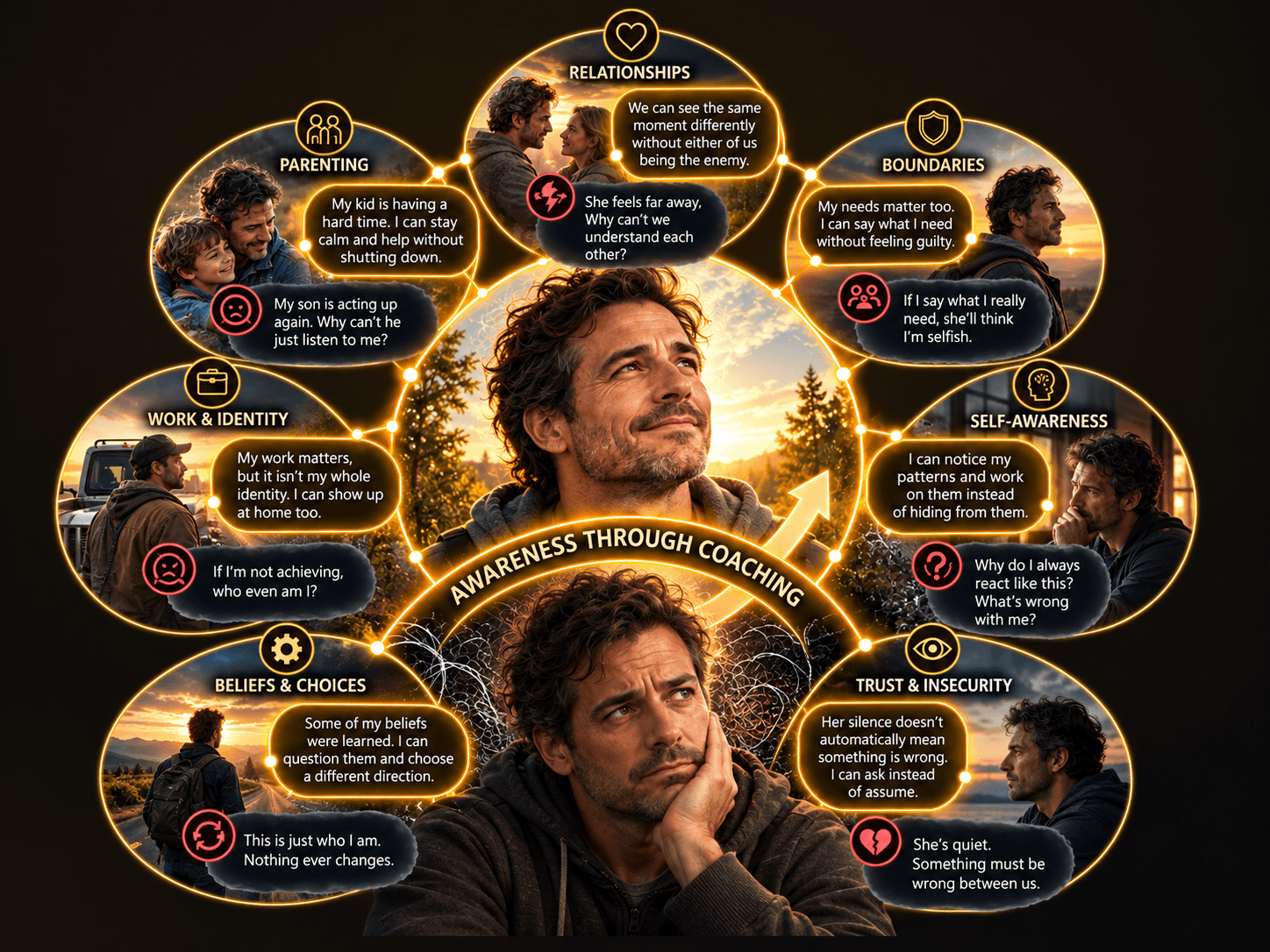
Illustration titled 'Awareness Through Coaching.' A man in his early forties appears twice: at the bottom, worried, resting his face in his hand; above, looking up with a calm, hopeful expression. Around him are seven scenes: relationships, parenting, boundaries, self-awareness, trust and insecurity, beliefs and choices, and work and identity, each pairing an anxious thought with a more aware one.

At home with his wife

Before

“She wants to talk again. I just got home. Why can't she leave it alone?”

Through awareness

“She's not attacking me. She's trying to reach me. Going quiet is how I disappear.”

With his kids

Before

“I snapped at him over nothing. Father of the year.”

Through awareness

“I can own it, say sorry, and try again. One bad moment doesn't have to be the story.”

In the truck

Before

“Ten more minutes. I'm not ready to walk in there yet.”

Through awareness

“I'm not avoiding my family. I'm gathering myself, and I can learn to walk in present instead of numb.”

Asking for help

Before

“Men like me handle it ourselves. I'm not paying someone to listen to me complain.”

Through awareness

“Handling it myself is what got me here. Getting help is a decision, not a weakness.”

Shame

Before

“What's wrong with me? Other guys seem to hold it together.”

Through awareness

“Nothing is broken in me. I learned ways to cope that don't work anymore, and learned things can be unlearned.”

At work

Before

“Work is the one place I know who I am. At home I feel like a stranger.”

Through awareness

“The man I am at work is real. I can learn to bring him home.”

Identity

Before

“This is just who I am. Provider. Fixer. Keep it moving.”

Through awareness

“That's who I learned to be. It's not the whole of who I am.”

An anatomically accurate human heart in deep red, lit with a warm ember-orange glow against a black background.

He has to feel safe before he can hear you.

Most ads get this wrong. The man you're trying to reach grew up being measured. His father judged his worth by his performance, so when an ad comes at him with that same pressure, confront this, prove that, he doesn't hear a coach. He hears control, and he runs. A man can't do real work in a body that doesn't feel safe. So the ad has to do the opposite. It has to hold space. It has to show him he won't be judged here, that he can let his guard down, that he's accepted as he is in this moment. When he feels that, he feels something he didn't get from his father: respect. That's when he stops. That's when rapport starts.

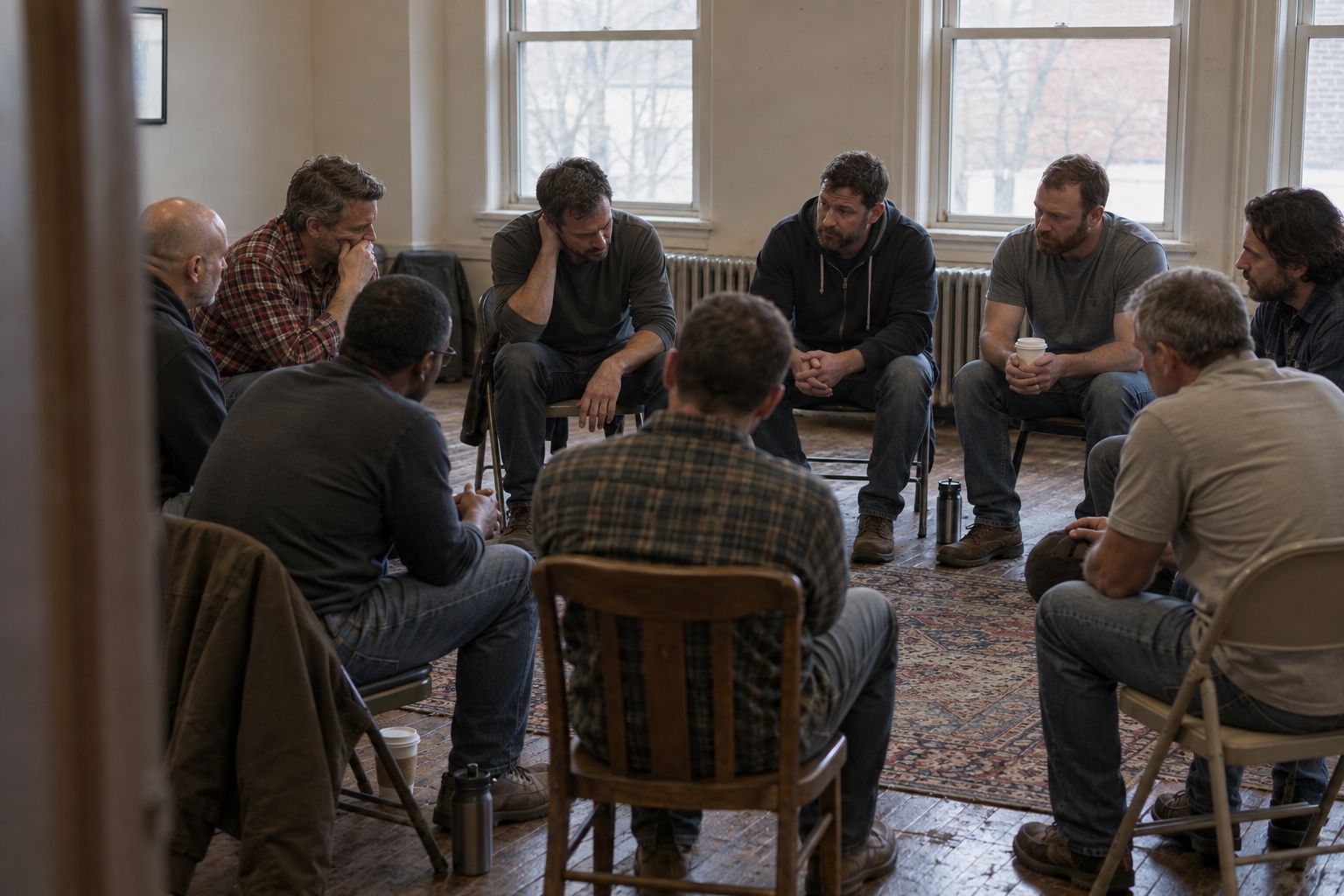
Ten men sit in a circle of plain chairs in a plain community room, one man quietly sharing something real while the others listen, a men's coach's room at work.

IS THIS A FIT?

Who we're best suited to work with

We work with established men's coaches: men's identity and inner-work coaches; marriage and relationship coaches who work with men; fatherhood coaches; and retreat and brotherhood leaders.

We tend to be a good fit if:

  • You have a defined program, retreat, or mastermind at $1,500 or more, and men have already paid for it.
  • Retreats and speaking are a plus. A room full of men beats a cold audience.
  • You can fund the initial 30-day test: a minimum US$1,000 Meta advertising budget, paid by you directly to Meta.
  • When a man raises his hand, there's a real next step: an application, a workshop, or a call that means something.
  • You do the work responsibly and don't sell exaggerated promises.

Men's performance masterminds and men's recovery coaches: sometimes. It depends on whether the real work is identity and inner work, not just output.

Not a fit: dating and pickup coaches, and pure fitness coaching. Different man, different problem, different ad.

Let's Talk →